
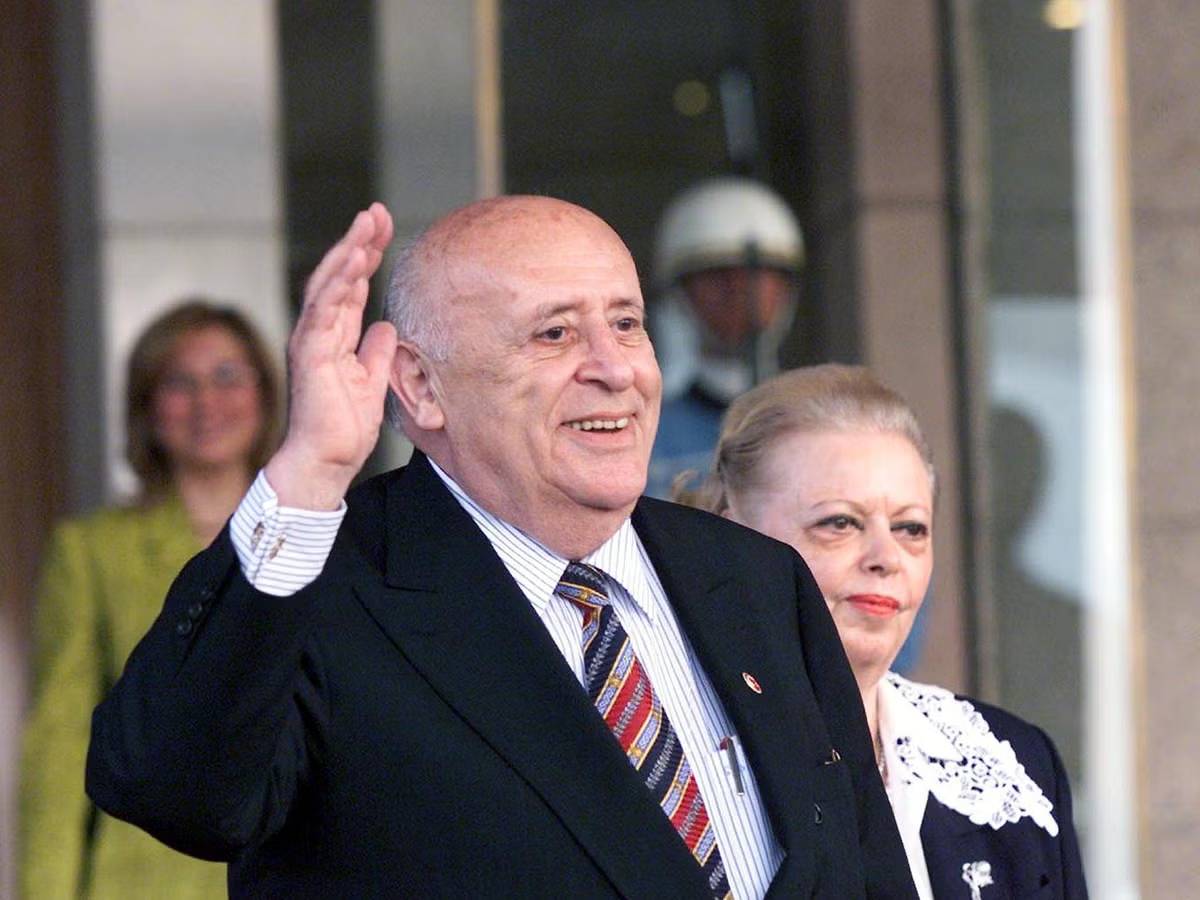
love4livi.com – Süleyman Demirel, the 9th President of Turkey, served from 1993 to 2000, leaving an enduring legacy in both the political and economic spheres of the country. Having already served as prime minister multiple times, Demirel’s presidency marked a period of significant transformation for Turkey. He presided over a time when the Turkish economy underwent modernization, with efforts to liberalize and integrate it further into the global marketplace. At the same time, Demirel’s political approach sought to strengthen democratic institutions and maintain political stability in a country that was often challenged by political fragmentation and economic volatility.
Early Life and Political Background
Süleyman Demirel was born on November 1, 1924, in Isparta, Turkey. Coming from a modest background, Demirel excelled in his studies, earning a degree in civil engineering from Istanbul Technical University. His early career saw him work in Turkey’s state-owned waterworks and infrastructure projects, where he developed a reputation for competence and leadership.
Demirel entered politics in the 1950s and quickly rose through the ranks of the Justice Party (Adalet Partisi, AP), which was aligned with Turkey’s center-right. His political career flourished in the 1960s and 1970s, leading to his first term as Prime Minister in 1965. Demirel served in this capacity multiple times, often leading coalition governments during a period of significant political instability in Turkey. His tenure was characterized by efforts to modernize the Turkish economy, though he faced challenges in navigating the tensions between the military, the political elite, and the people.
In 1993, following the death of President Turgut Özal, Demirel was elected as the 9th President of Turkey, marking the beginning of a new era in his political career.
Demirel’s Presidency: A Period of Economic Modernization and Political Stability
Süleyman Demirel’s presidency came at a time of significant economic and political change in Turkey. He inherited a country still struggling with the effects of hyperinflation, a large public debt, and political fragmentation. While the 1990s were a turbulent decade for Turkey, Demirel’s leadership sought to modernize Turkey’s economy and solidify its political institutions.
Economic Reforms and Modernization
One of Demirel’s most significant contributions during his presidency was his continued efforts to modernize the Turkish economy. Following the reforms initiated in the 1980s, Demirel sought to further integrate Turkey into the global economy. He worked on liberalizing the Turkish market by encouraging private sector growth, reducing trade barriers, and pursuing policies that attracted foreign investment.
The 1990s saw increased privatization of state-owned enterprises, which had previously dominated key sectors of the Turkish economy, such as telecommunications, energy, and transportation. Demirel’s government worked to reduce the state’s involvement in the economy, a process that had started in the 1980s under Turgut Özal, but which Demirel continued and expanded. These efforts helped reduce the government’s fiscal burden and improved efficiency in various industries.
However, despite these reforms, Turkey faced considerable challenges. Hyperinflation remained a serious issue throughout the 1990s, and the country’s economy remained volatile. Economic instability, rising debt, and high inflation rates were some of the difficulties that Demirel’s administration had to contend with. While many of the market-driven policies set the stage for growth, they also led to disparities, particularly in terms of regional economic inequalities. Furthermore, Turkey’s ongoing reliance on foreign loans to fund its economic growth put the country at risk of external shocks.
Political Stability and Democratic Governance
In terms of political reform, Demirel’s presidency was focused on ensuring political stability after the fractious 1990s. Turkey had faced a period of coalition governments, with frequent changes in leadership and political gridlock. Demirel worked to maintain a balance between the various political forces in Turkey, including the military, secularists, and Islamists, while also emphasizing the importance of Turkey’s integration with the West.
His leadership saw Turkey strengthening its relationship with the European Union. Demirel supported Turkey’s bid for EU membership and pushed for reforms to align Turkish laws with European standards. These efforts were part of Demirel’s broader vision of transforming Turkey into a modern, Western-oriented democracy. While full EU membership remained out of reach during his presidency, Demirel’s advocacy for the EU process laid the groundwork for future political reforms in Turkey.
Demirel also worked to improve Turkey’s relations with its neighbors, particularly in the Middle East and the Balkans. His foreign policy emphasized a balance between maintaining strong ties with Western powers, especially the United States and European countries, and improving diplomatic relations with Turkey’s neighbors.
Despite his diplomatic successes and economic modernization efforts, Demirel faced criticism for his inability to fully resolve Turkey’s internal political divisions, especially regarding the Kurdish issue. The 1990s were marked by an escalating insurgency by the Kurdistan Workers’ Party (PKK), and while Demirel sought peaceful solutions, his presidency did not see a definitive resolution to this long-standing issue.
Challenges and Political Fragmentation
The 1990s were a period of deep political fragmentation in Turkey. While Demirel tried to maintain a semblance of stability, coalition governments often lacked coherence, and the Turkish political landscape was dominated by tension between secularists, Islamists, and nationalists. This fragmentation resulted in frequent elections and political instability.
One of the most significant challenges Demirel faced was managing Turkey’s relationship with its military. While the Turkish military had long played a dominant role in politics, Demirel, who had also served as prime minister during previous military coups, navigated these relations carefully. His efforts to ensure civilian control over the military were ongoing, but the military’s influence over politics was still a dominant feature of Turkish society during his presidency.
Another major issue during Demirel’s presidency was the growth of political Islam, as the Welfare Party, led by Necmettin Erbakan, gained significant traction in the 1990s. The rise of Islamism presented a challenge to Turkey’s secular political system, and Demirel was forced to address the growing influence of Islamist political movements. This was particularly evident when the Welfare Party entered into a coalition government with Demirel’s own political party in the late 1990s.
Legacy and Impact
Süleyman Demirel’s presidency is often remembered for its efforts to modernize the Turkish economy and further democratize its political system. His tenure helped steer Turkey through a period of significant economic change and integration into the global market. However, despite these reforms, Turkey faced persistent challenges, including political fragmentation, economic instability, and unresolved social issues, particularly regarding the Kurdish conflict and the rise of political Islam.
Demirel’s legacy is also marked by his ability to maintain a delicate balance in Turkish politics, keeping democratic processes intact while managing the competing forces of secularism, nationalism, and Islamism. His diplomatic efforts to strengthen Turkey’s ties with Europe and the West were a significant aspect of his presidency, and his support for Turkey’s EU accession process was an important step in the country’s long-term political evolution.
Süleyman Demirel’s presidency was an important chapter in the history of modern Turkey, representing both the achievements and the challenges of a nation undergoing economic and political transformation. His leadership helped shape Turkey’s journey toward greater modernization, though many of the issues he faced—such as political fragmentation, economic volatility, and unresolved conflicts—would continue to be challenges for his successors. Nonetheless, Demirel remains an influential figure in Turkish politics, remembered for his role in shaping Turkey’s economic trajectory and political stability during a period of transition.
